Speech therapy letter templates

Published November 17, 2023 • Updated on September 25, 2026
Download our free therapy referral form template
Download now
Download our free therapy referral form template
Download nowIf you are a mental health therapist looking to streamline your practice operations, having a standard private practice referral request template on hand is essential. Whether you are transitioning a client to a specialist or referring out due to a full caseload, utilizing a clear referral request template guides your communication with other clinicians and maintains a high standard of care.
This article provides therapists with a referral letter example and a customizable referral request template to refer clients and connect with other clinicians. It also includes an overview of the benefits of referrals and a free downloadable private practice referral request template to save to your electronic health record (EHR).
Did you know that SimplePractice supports clinician referrals directly within the EHR? If you need to refer a client out to another therapist, you can easily do so directly within the platform in just a few clicks.
Clinicians can use a private practice referral request template to refer clients, or potential clients, to another mental health therapist, psychiatrist, or other provider. According to the American Psychological Association (APA), referring out is a critical ethical duty when a client's needs exceed a provider's competence.
Referrals typically happen for several distinct reasons:
For instance, you may have a dual relationship with a client or already treat a family member of theirs, which constitutes a conflict of interest. A private practice referral request template makes it easy to formally and ethically hand off the case.
Your practice may be full, and you may have a long client waitlist, necessitating a referral so clients can receive timely care. By keeping a referral list template of trusted peers, you can quickly distribute overflow.
On the other hand, if you are looking to grow your caseload, you can reach out to other clinicians with your own private practice referral request template to invite referrals to your practice.
You may not have expertise in the specific area the prospective client is seeking support in, or you may not provide particular assessments. For example, a client may seek a diagnosis for disability-related reasons. Perhaps you are a licensed marriage and family therapist (LMFT), but the client’s insurance company requires a clinical psychologist to complete the assessment.
Or, you may specialize in autism spectrum disorder assessments and want to use a referral letter example to make other clinicians in your network aware of your services.
You may decide to transfer a client's care if you are moving, changing jobs, or an issue arises in which you do not have the expertise to treat the client.
For instance, a client may initially present to your practice looking for support with work-related stressors. After a few sessions, it may become apparent they need support with obsessive-compulsive disorder (OCD). If this falls outside your areas of clinical competence, you need to use a formal referral letter to transfer them to an OCD specialist.
There are several benefits to actively using a standardized referral process in your daily operations, including:
Clinicians can only work within their scope of practice and levels of competence. Therefore, referring clients out ensures they receive the appropriate standards of care.
Sending a well-crafted referral letter example fosters relationships with other mental health clinicians and other healthcare professionals, such as primary care doctors, psychiatrists, and occupational therapists.
While it may not be a direct benefit, referring clients to other clinicians and noting your areas of expertise indirectly creates a reciprocal pathway for referrals back to your practice.
Referrals can be an effective way to acquire new clients within your chosen practice area, decreasing the need for external marketing efforts. Establishing a standard private practice referral request template saves administrative time and keeps your outreach consistent.
Each referral letter format may differ slightly depending on the specialty. However, an effective private practice referral request template should always contain the following information:
Your referral details: First and last name, email address, specialties, contact information, and preferred ways to contact you.
Client names: The client’s first and last name, pronouns, and preferred names.
Contact information: Email address, phone number, physical address, and preferred contact method.
Reason for referral: The reason you cannot see the client, such as a conflict of interest, or that their situation is outside your scope of practice.
Presenting problem(s): Relevant information about the client’s mental health or why they seek services.
Identity information: The client’s gender, sexuality, age, marital status, religion, and race, if relevant.
Areas of expertise: When seeking referrals from your network, it’s important to include your areas of competence and special interest areas.
The urgency of the referral: This may include a scale of how important it is that the person be seen quickly, with one being not that urgent and ten being extremely urgent.
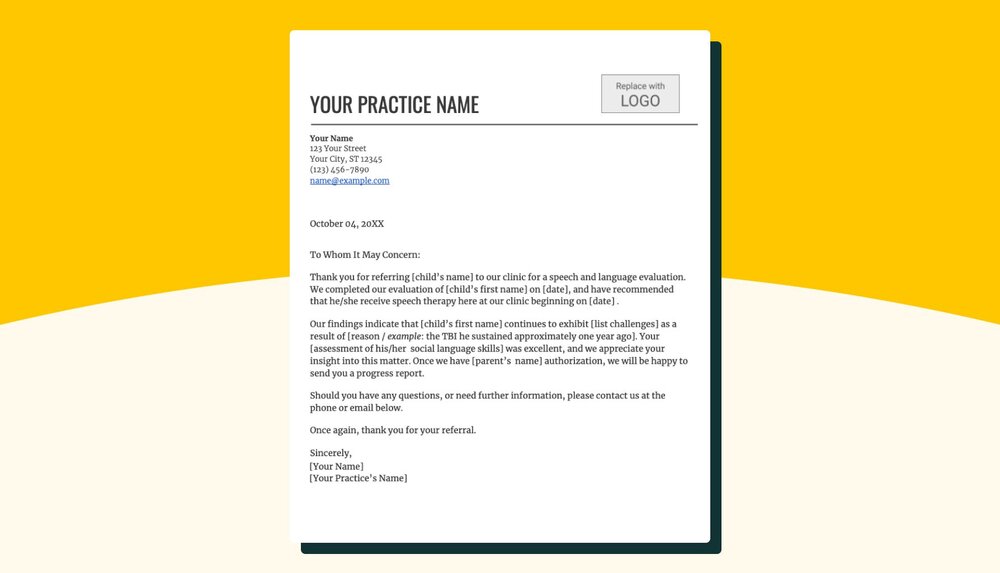
At the top of this article, you can download a free referral form example and sample referral letter that you can customize for your needs.
Here are some tips to keep in mind when filling out a private practice referral request template:
Use a standardized format: A therapy referral form template ensures you include all relevant details consistently.
Be brief: Provide concise and relevant client information, including background information, presenting problem(s), assessments conducted, diagnosis, and client goals.
Explain the rationale: Ensure you include the exact reason for the referral so the receiving clinician is clear about the client's clinical needs.
Include contact information: Include both the client’s contact information along with your own so the therapist knows how to reach out.
Proofread: Check the private practice referral request template for spelling, grammar, and accuracy.
Offer a consult: Mention your willingness to consult with the clinician as appropriate, especially if you are referring an existing client.
Looking for additional mental health letter templates? Download this collection of 18 therapist letter templates to modify and use in your practice.
Therapists and practice owners are occasionally asked to provide a referral letter for an employee—either referring a staff member to an Employee Assistance Program (EAP) or referring an employee to a specialized mental health provider.
When filling out a private practice referral request template for an employee, prioritize confidentiality and adhere strictly to HR and HIPAA guidelines.
Sample framework for an employee referral:
Header: Date, your name, and the receiving provider’s name.
Introduction: State that you are filling out a referral request template to refer an employee (with their written consent) for an evaluation or specific support services.
Context: Briefly describe the work-related observations or the employee's self-reported need for support, keeping clinical jargon to a minimum if you are acting as an employer rather than their therapist.
Goal: State the desired outcome, such as stress management or specialized clinical support.
Closing: Provide your contact information for any necessary administrative follow-up, ensuring the employee has signed a Release of Information (ROI) if you expect a return report.
Clinicians who work with adolescents are sometimes asked to write a referral or recommendation letter for a student applying to college. While this differs from a clinical referral letter example, the structure relies on similar professional boundaries.
When writing a letter for a student, focus on their strengths, resilience, and personal growth rather than detailing their clinical diagnosis or private trauma.
Key elements to include:
Relationship context: Explain how long you have known the student and in what capacity (e.g., as their counselor or therapist).
Character strengths: Highlight attributes like perseverance, emotional intelligence, and problem-solving skills.
Academic readiness: Connect their personal growth to their readiness for the rigors of higher education.
Consent: Always ensure the student and their legal guardian have provided explicit, written consent to disclose that they have been in therapy before sending the letter.
American Psychological Association. (2017). Ethical principles of psychologists and code of conduct.
Nosacek, C. J. (2021). Referral vs. transfer of care: Ethical options when values differ. The Linacre Quarterly.
SimplePractice is HIPAA-compliant practice management software with everything you need to run your practice built into the platform—from booking and scheduling to insurance and client billing.
If you’ve been considering switching to an EHR system, SimplePractice empowers you to streamline appointment bookings, reminders, and rescheduling and simplify the billing and coding process, plus easily refer out to other SimplePractice clinicians, all in one place—so you get more time for the things that matter most to you.
Try SimplePractice free for 30 days. No credit card required.






Proudly made in Santa Monica, CA © 2026 SimplePractice, LLC
Proudly made in Santa Monica, CA © 2026
SimplePractice, LLC